Salt Contamination Kits
Elcometer carries a range of kits suitable for measurement of pre-coating surface contamination.
It is essential that the level of contaminants on a surface is measured prior to application of the coating to ensure the quality of the coating and that its optimum lifetime is achieved.
If the coating is applied to a contaminated surface, which is not properly prepared, it could fail prematurely resulting in costly re-coating and high maintenance costs.
Price: $683.00
More Details
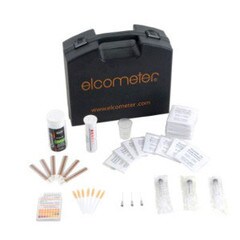
The Elcometer 138/2 Surface Contamination Kit provides the means for testing invisible surface contaminants.
Measuring the level of contaminants on a surface prior to application of the coating is essential to ensure the quality of the coating and that its optimum lifetime achieved.
Price: $625.00
More Details
All You Need in a Single Kit!
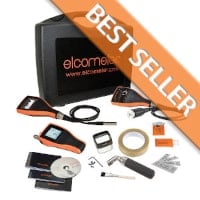
This kit comes complete with everything you need to comply with ISO 8502-6 ISO 8502-9 The Bresle Method . The Elcometer 135B is a self-adhesive rubber film patch with a sealed compartment used for taking samples of soluble salts.
The Elcometer 138 Bresle Kit includes the Elcometer 138 conductivity meter. The cartridge type sensor can be easily replaced when necessary and displays conductivity in a range of units including: S/cm, S/m, ppm and % salinity.
Price: $120.00
More Details
Chloride salts left on the surface before the first coat is applied can result in the coating system being forced off the surface by corrosion or blistering before the full life of the coating has been reached.
To ensure that the chloride has been removed it is essential that the surface is tested before the coating is applied.
Elcometer 134S test method: a latex sleeve is filled with a Chlor*Rid extract solution and stuck to the test surface where the solution is worked against the surface to extract the salts. The titration tube is inserted and the results can be recorded.
Price: $95.00
More Details
Chlorides deposited on a surface by contaminated abrasives during blasting can cause a coating to fail prematurely.
Contamination can build up, particularly if the blast media is recycled several times. Using the Elcometer 134A Chloride Ion Test for abrasives in the field will accurately identify contamination and prevent costly surface-related failures.
Results are recorded in parts per million (ppm) requiring no complicated calculations. Elcometer 134A test is designed to use a ratio of 1:1 for easy conversation to µg/cm².
Price: $105.00
More Details
If the chloride levels in the wash water are too high, this will promote premature corrosion, shortening the life of both steel and concrete structures.
Used to monitor recycled water to establish effectiveness of salt removal, this test is ideal when mixing concrete and when washing steel.
Results are given in ppm.
Price: $1,680.00
More Details
Please allow 1-2 weeks for delivery.
Designed to accurately, measure surface chloride, sulphate and nitrate ions in minutes, the Elcometer 134 CSN Salt kit offers a single kit solution for testing in the field.
All the components of the Elcometer CSN Test Kits are pre-measured and pre-dosed for trouble free testing.
Results are recorded in parts per million (ppm) requiring no complicated calculations. Elcometer 134 CSN tests are all designed to use a ratio of 1:1 for easy conversation to µg/cm².
Price: $240.00
More Details
Price: $4,699.00
More Details
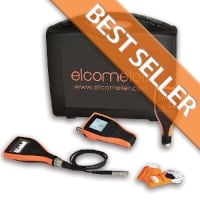
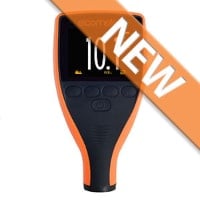
The Elcometer 130 Standard Salt Contamination Meter quickly and accurately measures the level of soluble salts on surfaces.
Price: $4,999.00
More Details
The Elcometer 130 Standard Salt Contamination Meter quickly and accurately measures the level of soluble salts on surfaces.
Price: $5,549.00
More Details
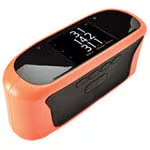
The Elcometer 130 Top Salt Contamination Meter quickly and accurately measures the level of soluble salts on surfaces.
Price: $5,999.00
More Details
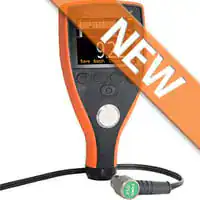
The Elcometer 130 Salt Contamination Meter quickly and accurately measures the level of soluble salts on surfaces.
Price: $6,699.00
More Details
Please allow 2-4 weeks for delivery.
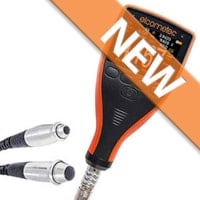
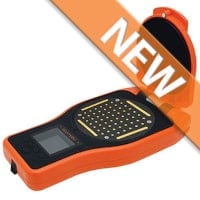
We are pleased to announce the launch the new Elcometer 130 SSP Soluble Salt Profiler.
The Elcometer 130 SSP provides fast and accurate measurement of the level and density of soluble salts on surfaces – and can provide Bresle equivalent values.
The multi-point measurement electrode not only provides four Bresle equivalent readings in just over two minutes – over four times faster than other Bresle equivalent test methods, but the user can also view a comprehensive salt distribution profile map – providing a more accurate indication of the amount of soluble salts on the test surface.
Key Features:
Bresle equivalent ISO 8502-9 test method; click here to view the full test method , results and conclusion on how the Elcometer 130 SSP compares to the Bresle Method
Automatic temperature compensation; the temperature of the wet filter paper is measured when placed on the measurement electrode and the reading adjusted accordingly – ensuring accuracy in all climatic conditions
Calibration offset; ensures accurate and repeatable readings by setting a filter paper and water offset on the gauge and adjusting the reading accordingly
Calibration verification; the accuracy of the gauge can be verified by the user and the verification date recorded in the gauge memory for use in reports
Price: $6,999.00
More Details
We are pleased to announce the launch the new Elcometer 130 SSP Soluble Salt Profiler.
The Elcometer 130 SSP provides fast and accurate measurement of the level and density of soluble salts on surfaces – and can provide Bresle equivalent values.
The multi-point measurement electrode not only provides four Bresle equivalent readings in just over two minutes – over four times faster than other Bresle equivalent test methods, but the user can also view a comprehensive salt distribution profile map – providing a more accurate indication of the amount of soluble salts on the test surface.
Key Features:
Bresle equivalent ISO 8502-9 test method; click here to view the full test method , results and conclusion on how the Elcometer 130 SSP compares to the Bresle Method
Automatic temperature compensation; the temperature of the wet filter paper is measured when placed on the measurement electrode and the reading adjusted accordingly – ensuring accuracy in all climatic conditions
Calibration offset; ensures accurate and repeatable readings by setting a filter paper and water offset on the gauge and adjusting the reading accordingly
Calibration verification; the accuracy of the gauge can be verified by the user and the verification date recorded in the gauge memory for use in reports